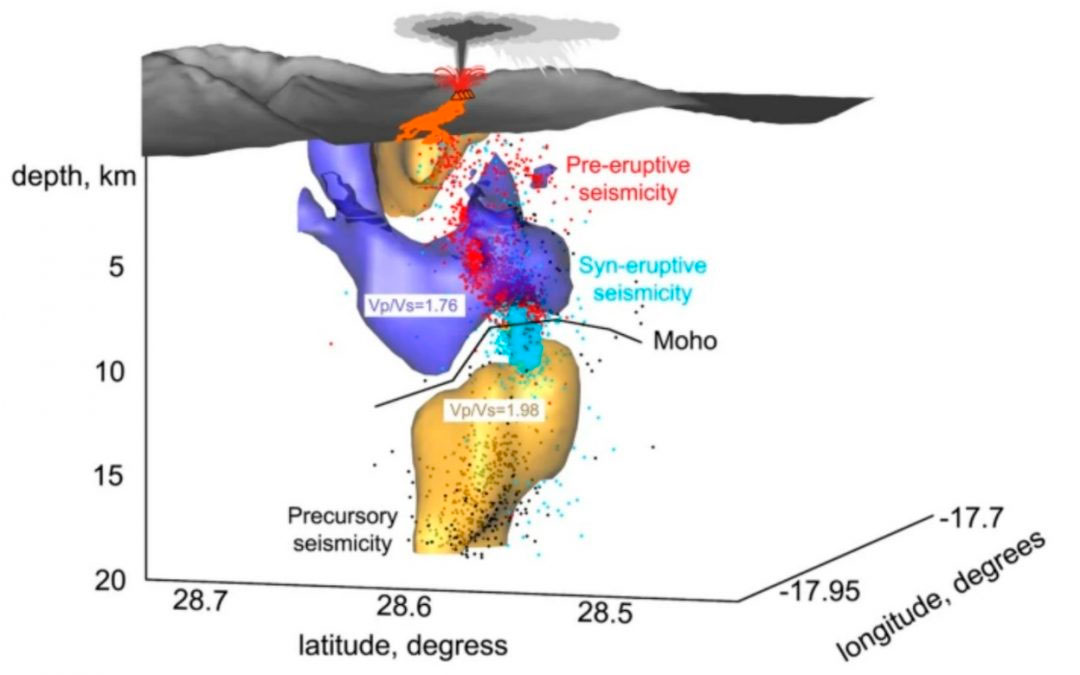
Photo: D’Auria, L., Koulakov, I., Prudencio, J., Cabrera-Pérez, I., Ibáñez, J. M., Barrancos, J., García-Hernández, R., Martínez van Dorth, D., Padilla, G.D., Pretor, M., Ortega, V., Hernández, P. Peréz, N.M. (2022). Rapid magma ascent beneath La Palma revealed by seismic tomography. Sci. Rep. 12:, 17654.
Effective volcano monitoring requires a combination of geophysical, geodetic, and remote sensing techniques to track changes in volcanic systems. This session will explore cutting-edge methods such as gravity and magnetotelluric surveys, drone-based campaigns, and thermal imaging to enhance hazard assessment. These techniques provide valuable insights into subsurface magma movements, fluid dynamics, and heat distribution, complementing traditional seismic and deformation monitoring. By integrating multiple data sources, researchers can better understand the complex interactions driving volcanic activity.
Discussions will focus on the advantages and challenges of these monitoring approaches, highlighting case studies where new technologies have improved early warning capabilities. Drone-based surveys, for example, allow high-resolution observations of inaccessible areas, while magnetotelluric methods help map deep conductive structures associated with magma reservoirs. Thermal cameras provide real-time data on surface temperature variations, aiding in eruption forecasting and assessing lava flow dynamics. Additionally, the session will address the role of artificial intelligence in processing and interpreting large datasets from these diverse monitoring systems.
This session will provide a platform for exchanging knowledge on emerging volcano monitoring technologies and their practical applications. Experts will discuss strategies for optimizing data collection, improving analysis techniques, and integrating different monitoring tools into early warning systems